It’s one thing to read that you can celebrate your birthday with NGO kids. It’s another to actually know what the day feels like — what happens when you walk in, how the children react, and whether it feels as meaningful in person as it sounds on a website. Here’s a realistic, hour-by-hour picture of what to expect.
Before You Arrive
Most celebrations start with a short phone call or WhatsApp conversation days or weeks earlier — confirming your date, what you’d like to include (cake, meals, ration, education support, or a mix), and roughly how many people you’re bringing. By the time your celebration day arrives, the NGO already knows what to expect, which means you won’t be figuring things out on the spot.
Arrival: Late Morning
At Naya Sawera Gurgaon, celebrations are typically scheduled around 12:00 PM, within the NGO’s working hours of 8:00 AM to 1:00 PM, Monday to Saturday. The NGO operates from Sector 82 and Sector 85, Gurgaon, Haryana. Arriving a little before noon gives you time to settle in, meet a staff member, and get a feel for the space before the children gather.
The first few minutes are usually quiet — a brief orientation, maybe a short explanation of how the day will flow. It’s normal to feel a little unsure of what to do with yourself in these first moments. That feeling doesn’t last long.
The Children Arrive
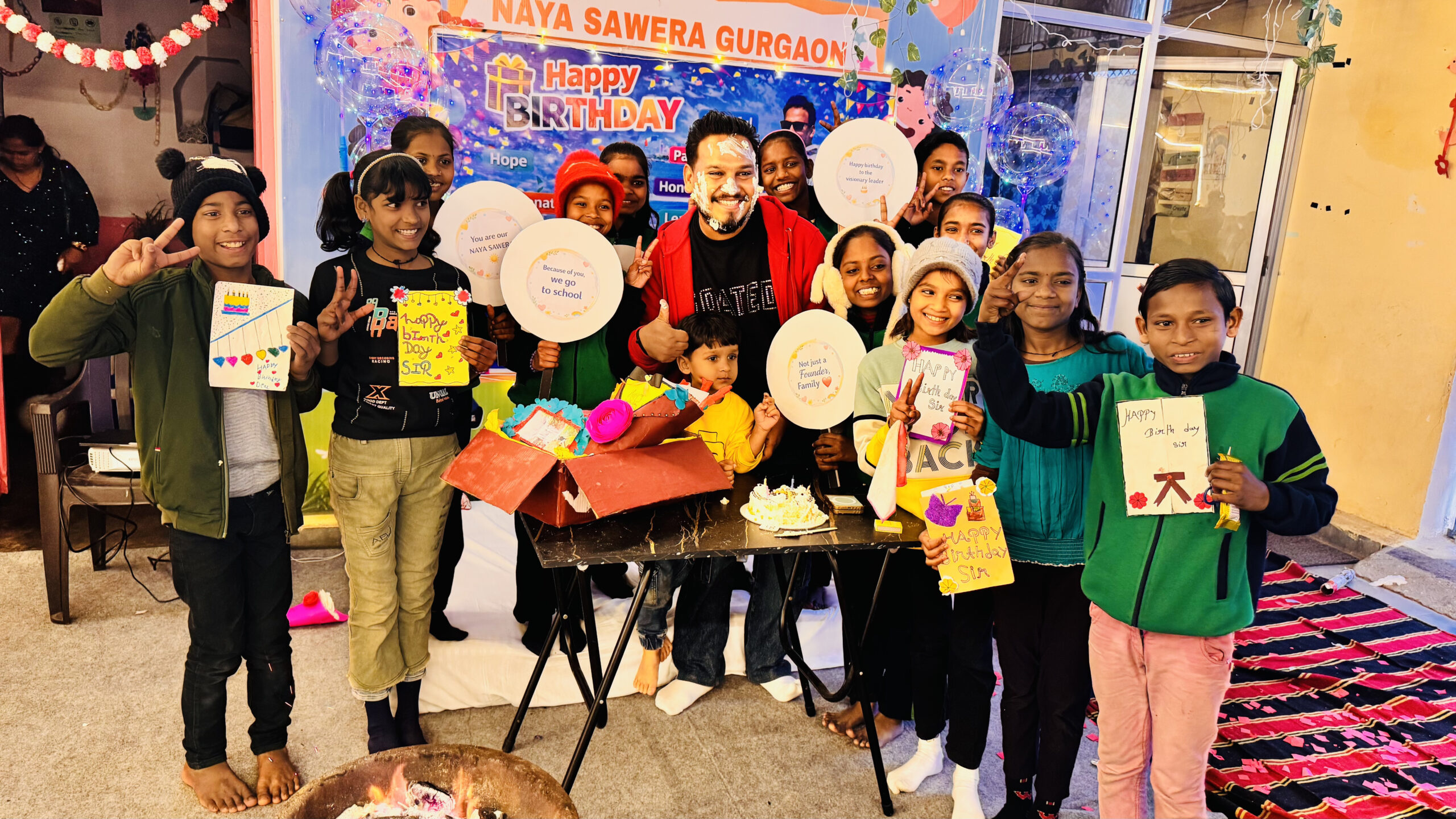
Typically, 160–180 children are present, though this varies by day. There’s rarely a formal announcement — children tend to gather naturally once they realize a celebration is happening. For many first-time visitors, this is the moment the day shifts from “an activity I planned” to something that actually feels real. The energy in the room changes quickly once cake is visible.
Cake Cutting
This is usually the centerpiece of the celebration. Unlike a typical birthday where cake cutting is a quick, almost ceremonial moment, here it tends to stretch out — children close in, some help hold the knife, most are simply excited to be near it. It’s less formal and considerably louder than a standard celebration, in the best way.
Sharing a Meal
If you’ve chosen to sponsor a meal as part of your celebration, this usually follows the cake. All food is prepared and coordinated directly through the NGO — a detail worth knowing, since outside cooked food and packaged snacks aren’t permitted, both for hygiene and to keep things fair across all the children present. Watching a place of 180+ children eating together, many for what might be their most special meal of the week, tends to be one of the quieter, more affecting parts of the day.
Games and Interaction
Depending on time and energy, this part of the day can look different every time – sometimes structured games, sometimes just conversation, sometimes children showing visitors around or asking questions. There’s no rigid script here. Most visitors describe this stretch as the part that surprises them most; conversations with the children are often unexpectedly funny, curious, or disarmingly direct.
Educational Support, If Included
If you’ve chosen to contribute books, stationery, or other school supplies as part of your celebration, this is often handled either during the visit or coordinated separately with the NGO team, depending on what you’ve arranged in advance.
Winding Down
By early afternoon, the celebration naturally starts to wind down, in line with the NGO’s 1:00 PM closing time. There’s rarely an abrupt end — more a gradual return to the day’s normal rhythm as children head back to their regular activities.
Leaving
Most people describe the drive home differently than they expected. The day rarely feels heavy or somber – if anything, most visitors leave energized, slightly overwhelmed, and already thinking about when they might come back. It’s common for people who celebrate this way once to return for future birthdays, or to start contributing beyond just the one visit.
How This Compares to a Typical Birthday
If you’re used to birthdays built around being celebrated — gifts, attention, a table full of people wishing you well — this day flips that entirely. You’re not the center of attention here, and most people find that’s exactly the point. The shift in focus, away from yourself and toward a room full of children who rarely get a day built around them, is often what makes this kind of celebration stick in memory longer than a typical party does.
What Happens After the Celebration Ends
For many visitors, this single visit becomes the start of an ongoing connection rather than a one-time event. Some return the following year for the same celebration. Others begin contributing in smaller ways throughout the year — sponsoring a meal here, contributing school supplies there — without waiting for their next birthday to reconnect. There’s no obligation to continue beyond your visit, but it’s worth knowing this is a common pattern if the day resonates with you the way it does for most first-time visitors.
What Surprises First-Time Visitors Most
A few things come up again and again from people experiencing this for the first time:
- How quickly the children warm up. There’s very little awkwardness once the celebration actually starts.
- How normal it feels. It’s not a solemn, heavy experience — there’s a lot of laughter.
- How little you need to manage. The NGO handles logistics; your role is simply to show up and be present.
- How different it feels from watching it in a video or reading about it. Most people say the described version undersells the actual experience.
What You Should Bring — and What to Leave at Home
You don’t need much. A camera if you’d like to remember the day is fine, though it’s worth staying present rather than spending the visit behind a lens. What you shouldn’t bring: outside cooked food or packaged snacks, since these aren’t permitted. If you’d like to contribute food, coordinate it directly with the NGO beforehand.
If You’re Nervous About How to Act
This is one of the most common hesitations people have before their first visit — not knowing how to behave, what to say, or whether they’ll do something wrong. In practice, there’s very little to get wrong. Being present, friendly, and willing to engage is really all that’s expected. The children set the tone far more than any visitor does.
Frequently Asked Questions
Is the day emotionally heavy? Not typically. Most celebrations feel joyful and energetic rather than somber.
Do I need to prepare anything to say to the children? No formal speech or activity plan is required — natural conversation and participation in games or the meal is enough.
Can I bring my own children along? Yes, and many visitors find this especially meaningful for their kids to experience.
How long does the whole visit typically take? Most celebrations fit comfortably within a couple of hours around the noon window, though this can vary based on what you’ve planned.
Ready to Experience This Yourself?
If reading through this walkthrough has made the idea feel more real, the next step is simple. Visit the Birthday, Anniversary & Special Day Celebration page to see full details, or reach out directly by calling or messaging 9625727908 / 8588809627 on WhatsApp to plan your date.
To hear from others who’ve experienced this day themselves, read the Impact Stories page, or learn more about the organization behind it all on About Us.
Our Google reviews tell the same story — 5.0 stars across 700+ reviews from people who’ve visited over the years.
Some birthdays are best described in a single sentence years later: “That was the year I celebrated with the kids at Naya Sawera.” This could be that year.